Most people accept persistent sinusitis, recurrent migraines, or nagging mental fog as unfortunate facts of modern life. They try decongestants, painkillers, and nasal sprays — and find that the relief, when it comes, is partial and temporary. What they rarely consider is that a treatment addressing these conditions has existed for over 3,000 years and is now attracting serious scientific attention. That treatment is Nasya therapy.
Nasya therapy, one of Ayurveda’s five Panchakarma treatments, involves administering medicated oils or herbal preparations through the nasal passages to treat a range of conditions affecting the head, neck, and nervous system. Nasya therapy’s benefits extend beyond the sinuses, reaching neurological health, cognitive function, sleep quality, and even cervical pain. Modern pharmaceutical science now validates what Ayurvedic physicians long ago observed. That the nose is a direct, effective gateway to the brain.
This article covers Nasya therapy comprehensively. What it is, how it works, the different types, the conditions it addresses, the evidence behind it, and everything you need to know before you seek it out. Read on, because the benefits of Nasya therapy are far broader than most people realise.
The Ayurvedic Foundation of Nasya Therapy
Classical Ayurvedic texts — the Charaka Samhita and the Sushruta Samhita — articulate a principle that modern neuroscience has spent decades rediscovering: Nasa hi shiraso dwaram — the nose is the gateway to the head. This was not a metaphor. It was a precise anatomical observation, made thousands of years before brain imaging or pharmacokinetics existed.
In Ayurvedic anatomy, the nasal passages connect directly to the brain, the sense organs, and the cerebrospinal fluid. Consequently, when practitioners administer medicated substances through the nose, they reach areas that oral medications often cannot access effectively. Nasya therapy targets the region above the clavicle — the head, neck, throat, sinuses, and sensory organs — making it specific and direct rather than systemic and diffuse.
Nasya therapy works on three simultaneous levels. Physically, it clears accumulated mucus (Kapha) and metabolic waste (Ama) from the nasal passages and sinuses. Neurologically, it reaches the brain and nervous system through the rich network of blood vessels and nerve endings in the nasal cavity. Energetically, it balances Prana Vata — the Ayurvedic subtype of Vata that governs breathing, mental function, and sensory perception. Together, these three levels explain why the benefits of Nasya therapy range across such a surprisingly diverse set of conditions.
The Science Behind Nasya Therapy: Why the Nose Is a Gateway to the Brain
The most compelling aspect of Nasya therapy, from a modern scientific perspective, is not the herbs it uses. It is the route of administration. Intranasal drug delivery has emerged as one of the most exciting frontiers in pharmacology and neuroscience. The reason is precisely what Ayurveda has known for centuries.
A review published in PubMed on nose-to-brain drug delivery mechanisms confirmed that the intranasal route transports drugs directly to the brain via the olfactory and trigeminal nerve pathways. These nerve pathways begin in the nasal cavity at the olfactory neuroepithelium and terminate in the brain, providing a direct conduit that entirely bypasses the gastrointestinal system. Furthermore, a separate PubMed review on nasal drug delivery to the CNS found that drugs administered nasally can travel along olfactory and trigeminal nerve pathways, reaching the cerebrospinal fluid and brain tissue — achieving therapeutic concentrations that would require substantially higher oral doses.
It is important to be precise here. The intranasal pathway does not wholly bypass the blood-brain barrier in all circumstances. Rather, the olfactory and trigeminal nerve pathways provide a direct neuronal transport route from the nasal epithelium to the brain — one that is anatomically distinct from the systemic bloodstream. Specifically, this is the route through which Nasya therapy exerts its neurological effects. The olfactory epithelium — the specialised tissue in the upper nasal cavity responsible for smell — connects directly to the limbic system, the brain region governing emotion, memory, and stress responses. This connection may explain why the benefits of Nasya therapy include improvements in anxiety, sleep, and mental clarity alongside its physical effects.
The Five Types of Nasya Therapy — and When Each Is Used
Nasya therapy is not a single intervention. Ayurvedic texts classify it into five distinct types, each suited to a different therapeutic goal, constitution, and set of conditions. Understanding these distinctions clarifies why Nasya therapy addresses such a broad range of health concerns.
1. Navana Nasya — Nourishing Nasya
Navana Nasya uses medicated oils or ghee to lubricate, nourish, and strengthen the nasal passages and nervous system. This is the most commonly administered form and the most familiar to general wellness seekers. It is particularly indicated for Vata imbalances — dryness, anxiety, insomnia, mental restlessness, and cognitive fatigue. Anu Tailam, a classical polyherbal oil, is the most widely used preparation for Navana Nasya.
2. Shodhana Nasya — Cleansing Nasya
Shodhana Nasya employs stronger formulations specifically designed to remove deep-seated toxins and excess Kapha from the head and sinuses. This intensive form is used for chronic sinusitis, severe nasal congestion, and conditions characterised by significant blockage or accumulation. Consequently, it is one of the primary Nasya approaches for respiratory and sinus conditions.
3. Shamana Nasya — Palliative Nasya
Shamana Nasya uses milder preparations to balance the doshas and manage specific symptoms without the intensity of full cleansing. This type suits ongoing maintenance, prevention, and patients who need a gentler approach. It is frequently used in the long-term management of chronic conditions.
4. Pradhamana Nasya — Insufflation
Pradhamana Nasya involves administering dry herbal powders directly through the nasal passages. Practitioners typically use this approach for acute conditions requiring immediate action, or for individuals who cannot tolerate oil-based preparations. The powders stimulate both strong cleansing and drainage responses.
5. Pratimarsha Nasya — Daily Preventive Practice
Pratimarsha Nasya is the gentlest form. Just two to four drops of appropriate medicated oil daily, self-administered each morning before breakfast. Ayurvedic tradition recommends it as a foundational daily wellness practice for healthy individuals. Its benefits include maintaining nasal passage health, supporting cognitive function, enhancing sensory clarity, and preventing the accumulation of Kapha in the head over time. Notably, this is the one form of Nasya therapy that can be safely incorporated into a home wellness routine under initial practitioner guidance.
The Benefits of Nasya Therapy: Conditions That Respond Well
The benefits of Nasya therapy span a remarkable range of conditions — from the sinuses to the cervical spine to sleep quality. Here is what both the classical texts and the emerging clinical evidence show.
Chronic Sinusitis and Nasal Congestion
Sinusitis is Nasya therapy’s most established clinical application. A 2023 multi-centre clinical study published in the Journal of Research in Ayurvedic Sciences enrolled 120 patients with chronic rhinosinusitis. After three treatment cycles of Nasya with Shadbindu Tailam over 42 days, participants showed statistically significant improvements in the Rhino Sinusitis Disability Index (RSDI), the SNOT-20, and the Lund-Mackay CT scores. Importantly, the formulation produced no adverse effects on liver or kidney function, and no participants withdrew due to tolerability issues. Additionally, a comparative clinical trial published in the International Journal of Ayurvedic Medicine in 2024 found that Virechana Nasya with Nimbasava and Sigru Beeja produced outcomes comparable to those of conventional treatment with antibiotics and a corticosteroid nasal spray in acute exacerbation of chronic rhinosinusitis — a remarkable result for a purely herbal intervention.
Headaches and Migraines
Both tension headaches and migraines feature prominently in classical Ayurvedic indications for Nasya therapy. Ayurveda classifies migraine as Ardhavabhedaka — a condition characterised by Vata and Pitta imbalance in the head. A double-blind randomised controlled trial published in ScienceDirect enrolled 90 migraine patients and evaluated Nasya karma with Vrihatajivakadya oil of different viscosities. Both groups showed significant improvements in migraine frequency, severity, and associated symptoms. Thus, the study provides the first RCT-level evidence for a specific Nasya protocol in migraine management. Furthermore, the direct nasal-to-brain delivery mechanism offers a biologically plausible explanation: medicated oils reach the trigeminal nerve pathways directly, potentially reducing neurogenic inflammation at its source.
Cervical Spondylosis and Neck Pain
One of the most rigorously studied benefits of Nasya therapy is its effect on cervical spondylosis — a degenerative disease of the cervical spine causing neck pain, stiffness, and radiating arm pain. A randomised controlled clinical trial published in the journal Ayu found that patients who received Nasya with Dhanwantaram Tailam for seven days, alongside conservative management, showed a mean pain reduction of 3.5 points, compared with 1.3 points in the control group (P<0.001). The between-group difference was highly statistically significant. Moreover, a comprehensive review of nine clinical trials on Nasya for cervical spondylosis found consistent improvements across Visual Analogue Scale pain scores, Neck Disability Index scores, and range-of-motion measurements — validating Nasya’s role in what Ayurveda categorises as Manyastambha (Vata disorder of the neck).
Insomnia and Sleep Quality
Sleep disturbance is one of the most valuable — and least discussed — benefits of Nasya therapy. A randomised open-label clinical study published in PMC enrolled 60 elderly patients with primary insomnia. Patients receiving combined Brimhana Nasya (with Ksheera Bala Taila) plus Ashwagandha achieved 86.66% relief in subjective sleep quality, 89.15% improvement in sleep duration, and 90.14% improvement in sleep efficiency — all with P<0.0001. Critically, the combined Nasya-plus-Ashwagandha group significantly outperformed the Ashwagandha-only group across every sleep parameter, demonstrating that the Nasya component contributed independently to the outcomes. The mechanism is consistent with the neurological action of Nasya: reducing Vata, calming the nervous system, and delivering neuroprotective oil compounds directly to the limbic pathways governing sleep regulation.
Mental Clarity, Memory, and Cognitive Function
Classical Ayurvedic texts explicitly recommend Nasya therapy for improving medha (intellect), smriti (memory), and prajna (wisdom). These are not vague aspirations. In fact, they reflect the understanding that Prana Vata, which governs mental function, is directly accessible through the nasal route. Modern pharmacology also supports this: the olfactory epithelium’s direct connection to the hippocampus and limbic system means that intranasal delivery reaches brain regions governing memory formation and emotional regulation. Regular Nasya therapy — particularly Pratimarsha Nasya as a daily practice — is increasingly being explored for supporting cognitive health in ageing populations, with the insomnia trial above also demonstrating improved daytime mental alertness as a secondary outcome.
Allergic Rhinitis, Facial Paralysis, and Sensory Organ Health
The benefits of Nasya therapy extend further still. A randomised double-blind placebo-controlled trial published in the Clinical Respiratory Journal found that a Nasya-based nasal preparation significantly reduced total nasal symptom scores and total ocular symptom scores in patients with allergic rhinitis from house dust mite exposure — compared to saline placebo. Classical texts also document Nasya therapy for facial paralysis (Bell’s palsy), where the direct cranial nerve access provides a plausible mechanism for nerve nourishment and regeneration. Additional applications include tinnitus, voice hoarseness, eye strain, and premature greying — areas where rigorous RCT evidence remains limited but the anatomical rationale is sound.
The Nasya Therapy Procedure: What to Expect Step by Step
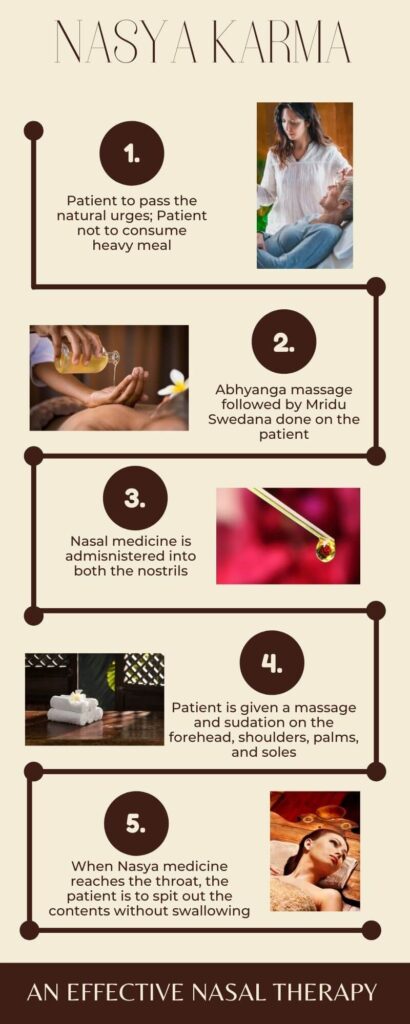
Understanding the procedure demystifies Nasya therapy for first-time seekers. The process involves three well-defined stages, each serving a specific therapeutic purpose.
Stage 1 — Preparation (Purvakarma)
The session begins with preparation of the head, neck, and shoulders. The practitioner applies warm medicated oil in a gentle Abhyanga (massage) to the face, scalp, and shoulders. This loosens accumulated Kapha, relaxes the tissues, and also opens the nasal channels. Mild steam application (Swedana) follows, further warming the passages and ensuring the medication penetrates deeply rather than draining superficially. The individual should arrive fasting — or at least two hours after a light meal — with natural urges already passed.
Stage 2 — Administration (Pradhanakarma)
The individual lies on a treatment table, head tilted back approximately 45 degrees. This positioning is precise — it ensures that the medication travels through the nasal passages and sinus spaces rather than draining immediately down the throat. The practitioner instils the prescribed medicated oil using a dropper. Typically four to eight drops per nostril for standard Navana Nasya. The individual breathes gently and naturally throughout. Most people find the sensation soothing. Some formulations produce a mild warmth or tingling that subsides quickly.
Stage 3 — Post-Procedure Care (Paschatkarma)
After instillation, the individual rests for one to two minutes to allow absorption. Then, a gentle massage of the soles, palms, and shoulders follows. When medication eventually reaches the back of the throat, the individual spits rather than swallows — this is the conventional recommendation, as the preparation is medicinal rather than for ingestion. Complementary procedures may follow, including Dhumapana (medicated smoke inhalation) or Gandusha (oil pulling), to reinforce the therapeutic effect.
Who Should Not Receive Nasya Therapy — Important Contraindications
Nasya therapy is safe when properly administered by a trained practitioner. However, classical texts identify specific contraindications that modern practice continues to observe. Nasya therapy should not be administered to individuals who:
- Have eaten within the past two hours.
- Are suffering from acute fever or active infection.
- Are pregnant (except under specific, supervised medical guidance).
- Are children under seven or elderly patients over eighty (dose modifications are required in both groups).
- Have taken a head bath within the past 24 hours.
- Are intoxicated, severely fatigued, or in acute emotional distress.
Seasonal timing matters as well. Spring (Vasant Ritu) is traditionally considered optimal for preventive Nasya, because the body’s natural dosha shifts make cleansing therapies most effective during this season. However, therapeutic Nasya is administered year-round when clinically indicated. Post-procedure, avoid cold wind, dust, and smoke; do not take a head bath for at least 24 hours; eat warm, light, and easily digestible food; and prefer warm water over cold beverages. These restrictions typically apply for three to seven days.
How to Access Nasya Therapy: Practical Guidance
If the benefits of Nasya therapy have convinced you to explore it, several practical considerations will help you do so safely and effectively.
- Find a qualified practitioner. In India, look specifically for practitioners with BAMS (Bachelor of Ayurvedic Medicine and Surgery) qualifications and dedicated Panchakarma training. Outside India, seek practitioners certified by recognised Ayurvedic institutions. Nasya therapy requires proper training — the selection of oil, dosage, preparation, and sequencing all depend on the individual’s constitution and condition.
- Understand the course commitment. Therapeutic Nasya typically runs for 7 to 21 days, depending on the condition. Daily or alternate-day sessions may be required. This is a treatment process, not a one-time procedure — consistency directly determines outcomes.
- Consider Pratimarsha Nasya for home practice. After an initial clinical course, the gentle daily practice of two to three drops of Anu Tailam in each nostril each morning is widely recommended for prevention and maintenance. This can be self-administered safely at home once a practitioner has assessed your suitability.
- Time it correctly. Morning, after oral hygiene and evacuation but before breakfast, is the traditional optimal time. Avoid Nasya during menstruation, after heavy meals, or when acutely unwell.
Nasya Therapy in the Bigger Picture: Where Ancient Wisdom and Modern Science Converge
What distinguishes Nasya therapy from conventional nasal treatments is not merely the use of herbal oils rather than pharmaceutical sprays. It is the underlying philosophy. Western medicine approaches nasal treatments as local interventions — decongestants for blockage, steroids for inflammation, and antibiotics for infection. Each targets a specific symptom in a specific location.
Nasya therapy operates differently. While it certainly addresses local symptoms, its primary goal is systemic rebalancing. The nasal passage serves as a portal that influences not only the sinuses but also the entire head region, the nervous system, the sense organs, and mental and emotional states. This is why a person seeking Nasya therapy for chronic sinusitis may simultaneously experience improved sleep, reduced anxiety, and sharper concentration — not as side effects, but as interconnected expressions of restored balance.
The convergence between Ayurvedic theory and modern intranasal pharmacology is one of the more remarkable stories in contemporary integrative medicine. Ancient physicians identified the nasal route as a direct pathway to the brain. Contemporary researchers have confirmed the anatomy, mapped the olfactory and trigeminal nerve pathways, and are now developing nanoparticle-based intranasal drug delivery systems for conditions from Alzheimer’s disease to Parkinson’s. The principle is identical. The science is catching up.
For individuals dealing with conditions that conventional medicine manages but does not resolve — chronic sinusitis, recurring migraines, cervical pain, disturbed sleep, and persistent mental fog — the benefits of Nasya therapy deserve serious consideration. This is an ancient practice with a growing evidence base, a strong safety profile when properly administered, and a depth of understanding of the head and nervous system that remains impressively relevant 3,000 years after it was first documented.
The Bottom Line
Nasya therapy is not a niche curiosity. It is a sophisticated, well-documented, and increasingly evidence-supported Ayurvedic treatment system with a uniquely direct mechanism of action. Its benefits span sinusitis and migraines through to cervical spondylosis, insomnia, and cognitive support — a range that makes sense once you understand that the nasal passage is, as ancient physicians knew, the gateway to the head.
Modern science has confirmed the anatomy. Clinical trials are beginning to confirm the outcomes. What remains is for more people to discover that a safe, effective, and extraordinarily well-reasoned therapeutic tradition has been waiting patiently — all 3,000 years of it — for them to take notice.
Disclaimer: This article is for informational and educational purposes only and does not constitute medical advice. Always consult a qualified Ayurvedic practitioner (BAMS) or your primary healthcare provider before undertaking Nasya therapy or any Panchakarma procedure.
