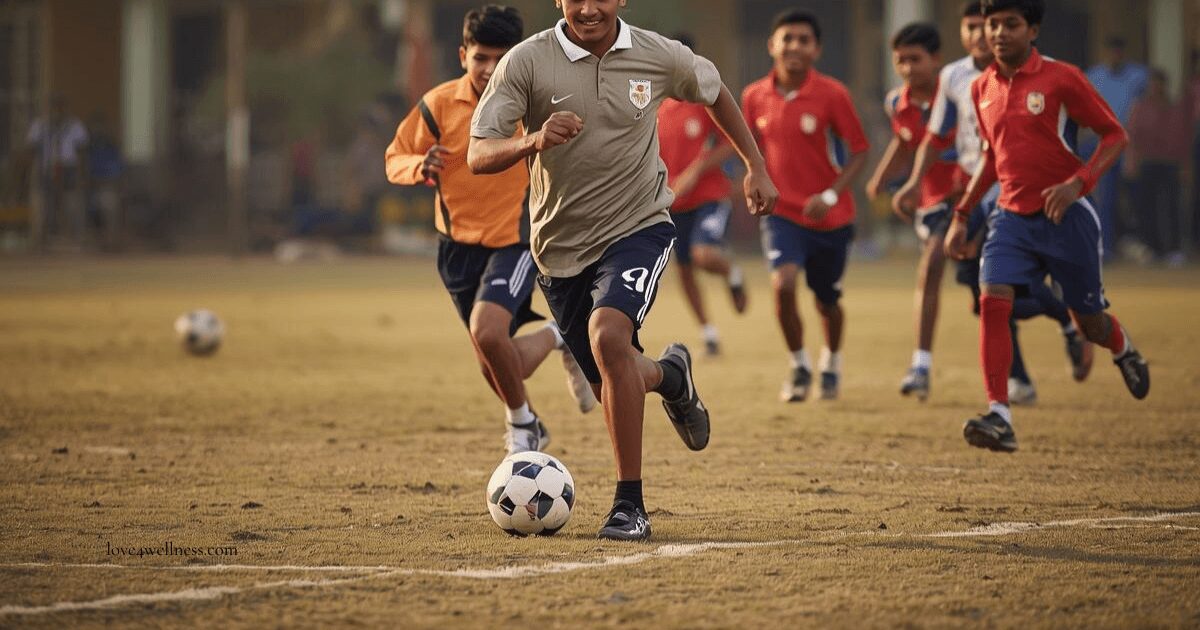
Picture this: you’re sitting in your fifth-period class. Your eyes are glazing over. The words on the board have started to blur. You can feel your brain slowly shutting down — like a phone at 3% battery. You’re not being lazy. You are not stupid. You’re just a human being who has been sitting still for five hours straight. This is just one of the reasons we need to talk about the benefits of physical education in schools.
Now imagine you’d had PE before that class instead of after it.
Here’s the thing — that’s not just wishful thinking. The benefits of physical education on your brain are real, measurable, and backed by some of the most exciting science in neuroscience today. Yet in schools across India, PE is still treated like the least important period of the day. It gets replaced by an extra math class, moved to after exams, or simply cancelled when the timetable gets tight.
This article is for every student who’s ever been told that PE is a waste of time. Spoiler: it’s the opposite.
What Actually Happens Inside Your Brain When You Move
Before we get into PE class specifically, let’s talk about what exercise does to your brain — because it’s genuinely wild.
When you get physically active, your heart starts pumping faster. Blood rushes to your brain, carrying oxygen and glucose — essentially premium fuel for thinking. But that’s just the beginning. Exercise also triggers the release of a protein called Brain-Derived Neurotrophic Factor, or BDNF. Harvard psychiatrist Dr John Ratey — one of the world’s leading authorities on exercise and the brain — famously called BDNF “Miracle-Gro for the brain.” And that nickname is remarkably accurate.
When researchers sprinkled BDNF onto neurons in a petri dish, the cells spontaneously sprouted new branches — the same structural changes that happen when you learn something new. In other words, exercise literally causes your brain to grow. New connections form. Existing ones strengthen. Your brain becomes more ready to absorb new information — like freshly watered soil, ready to receive seeds.
🧠 Fun fact: In a German study, participants who did brief sprints during a treadmill session learned new vocabulary words 20% faster than those who didn’t exercise. Not 20% more words. 20% faster. The sprint essentially turned their brains into learning machines.
And there’s more. Exercise also floods your brain with dopamine (the motivation chemical), serotonin (the mood stabiliser), and norepinephrine (which sharpens focus and attention). Dr Ratey puts it bluntly: a good workout produces effects in the brain that are similar to taking a small dose of Ritalin — the medication used for ADHD. That’s how powerful movement is.
So no, PE class isn’t interrupting your education. It’s setting your brain up for it.
The Naperville Story: The School That Proved It
If you’re still not convinced about the benefits of physical education, let’s talk about Naperville, Illinois — a suburb of Chicago that quietly conducted one of the most remarkable education experiments in recent history.
The PE teachers at Naperville Central High School had a radical idea. Instead of scheduling PE in the afternoon, they moved it to the first thing in the morning — before academic classes. Students came in at 7:45 AM, got their heart rates up on treadmills and other equipment, and then went straight to their hardest classes. They called it Zero Hour PE.
The results were extraordinary. Students who had PE directly before their reading comprehension class read half a year ahead of peers who hadn’t exercised. And in mathematics, students who exercised before their pre-algebra class improved their standardised test scores by 20.4% — compared to just 3.87% for the control group who didn’t exercise beforehand.
Naperville High School went on to become one of the top 10 performing schools in Illinois, spending less per student than other schools in their district. When the school’s 8th graders sat for an international science and maths test taken by students around the world, they ranked just ahead of Singapore in science, number one globally at the time. In maths, they ranked sixth in the world.
All of this, because of PE.
One student who participated in the programme, Nadlene Alnass, described the effect simply: after PE, she could “focus more on the teacher, more on the lessons, more on everything.”
That’s not an accident. That’s neuroscience.
The Benefits of Physical Education for Your Brain — Section by Section
Memory and Learning
Let’s go back to BDNF for a moment, because its effect on memory specifically deserves its own spotlight.
BDNF is most active in the hippocampus — the part of your brain responsible for converting short-term memories into long-term ones. It’s the region that decides what to store and what to discard. Aerobic exercise boosts the volume of the hippocampus, making it physically larger and more capable. A larger, better-nourished hippocampus means better recall of formulas, dates, concepts, and everything you’re being asked to remember for your exams.
A comprehensive analysis of 133 randomised controlled trials found that exercise produced a measurable boost in cognition across all ages — and that kids and teenagers showed the biggest increase in memory of any age group. Your brain is currently at peak plasticity, which means it responds to exercise more powerfully than an adult brain would. You’re getting the biggest return on every single PE period.
Focus and Attention
A systematic review published in Frontiers in Psychology found that physical exercise significantly enhances executive function in adolescents, which includes attention, working memory, and the ability to filter out distractions. Basically, everything you need to sit through a 50-minute lesson without losing the thread.
Research from the University of Nevada also found that students who were more physically active were more focused, stayed on task longer, and had better short-term memory than their sedentary peers. This isn’t a small difference in performance. It’s the difference between remembering what your teacher said five minutes ago and having absolutely no idea.
Maths and Reading, Specifically
Here’s something particularly relevant if your teachers or parents keep telling you to study more maths and English: research from the University of Southern California found that regular physical activity improved standardised test scores in maths and reading above other subjects. Not science. Not history. Maths and reading are the two subjects that receive the most academic pressure in Indian schools.
The reason comes down to the prefrontal cortex — the part of the brain responsible for reasoning, problem-solving, and processing language. Exercise increases blood flow specifically to this region, making it more active and more efficient. So when you go from PE to your maths class, your prefrontal cortex is essentially running on a full tank.
The Benefits of Physical Education for Your Mental Health
Your Body’s Built-In Anti-Stress System
You’ve probably heard of endorphins — the chemicals often associated with the “runner’s high.” But here’s what most people don’t know: exercise reduces your levels of cortisol and adrenaline — the hormones your body releases during stress. At the same time, it ramps up endorphins, which are natural mood elevators and painkillers. The result is a physiological reset that no amount of lying on the sofa can replicate.
If you’ve ever felt genuinely lighter after a cricket match, a run, or even a long walk — that’s not your imagination. That’s your neurochemistry working in your favour.
“Exercise has a dramatic antidepressive effect. It blunts the brain’s response to physical and emotional stress.”
— Dr David Linden, Professor of Neuroscience, Johns Hopkins University School of Medicine
Exam season is stressful. Family expectations are stressful. Social pressure is stressful. Movement is one of the few things that directly interrupts the stress cycle — not by ignoring the stressor, but by chemically altering how your brain responds to it. Regular exercise also strengthens your brain’s ability to handle future stress — so the more consistently you move, the more resilient you become. PE class, in other words, isn’t just good for today. It’s building your capacity to handle pressure for the rest of the year.
Anxiety and Depression
The statistics here are sobering. According to the WHO, 14% of 10-19-year-olds globally experience a mental health condition, and depression and anxiety are the leading causes of illness and disability in this age group.
Physical activity is one of the most well-studied non-clinical interventions for both. A 2025 meta-analysis published in BMC Public Health, which looked at 30 studies involving children and adolescents, found that physical activity interventions were significantly more effective than control groups at improving mental health, with particularly strong effects on stress reduction and social competence. For mild to moderate depression, research suggests exercise can be as effective as antidepressants or cognitive behavioural therapy. That’s not a throwaway claim — that’s peer-reviewed science.
And here’s something worth sitting with: regular physical activity has also been linked to lower rates of risk-taking behaviour, increased self-esteem, and a greater sense of belonging — especially in adolescents who play team sports. Social connection is one of the most powerful protectors of mental health at any age, and PE is one of the few spaces in the school day where that connection happens naturally, without grades attached.
The Mood-Academic Connection
This part is less talked about, but it matters enormously: your emotional state directly affects your ability to learn. An anxious brain is a distracted brain. A depressed brain struggles to retain information. A stressed-out student sitting in a classroom isn’t actually taking in what the teacher is saying — they’re just going through the motions.
Exercise addresses this directly. When your mood improves, your concentration improves with it. When your stress drops, your brain has more capacity to focus. The benefits of physical education, therefore, aren’t just physical or even purely cognitive — they’re emotional, and that emotional shift ripples into everything else.
The Benefits of Physical Education for Your Social Skills
Here’s one benefit of physical education that nobody puts on the poster: it teaches you how to be around people.
That sounds simple. It isn’t. Social skills — knowing how to communicate, cooperate, handle conflict, lead, follow, win gracefully, and lose without sulking — are some of the most complex skills a human being develops. And it turns out, the sports field and the gym are surprisingly good classrooms for all of them.
Research published in the Journal of School Health found that students who regularly participated in physical education reported significantly better social competence — including stronger communication skills, greater empathy, and a better ability to work in teams — than students who didn’t. These aren’t soft, unmeasurable outcomes. They are skills that employers, universities, and relationships will demand of you for the rest of your life.
You Learn to Read People — Fast
Team sports, in particular, are essentially real-time social simulations. When you’re on a cricket pitch or a football field, you’re constantly reading your teammates — their body language, their positioning, their hesitation, their confidence. You’re making split-second decisions about when to pass, when to hold back, when to step up. Studies show that children and teenagers who play team sports develop stronger non-verbal communication skills and are better at interpreting social cues than those who don’t.
This matters far beyond the field. Reading a room, picking up on a friend’s mood, knowing when to speak and when to listen — these are the same skills, just in a different setting.
You Learn How to Handle Conflict
PE is one of the few spaces in school where disagreements occur in real time and must be resolved in real time. Someone made a bad call. A teammate is hogging the ball. The other team is playing rough. You can’t raise your hand and ask the teacher to sort it out — you have to navigate it yourself, on the spot, with your emotions running high.
Researchers at the University of Alberta found that sport participation in adolescence was directly linked to better conflict resolution skills in adulthood — including the ability to stay calm under pressure, compromise, and advocate for themselves without aggression. In other words, PE is quietly teaching you negotiation skills. Your future workplace will thank you.
You Build Belonging
There is something uniquely powerful about shared physical effort. Running the same laps, struggling through the same drill, celebrating the same win — these experiences build a kind of bond that a classroom rarely produces. Studies consistently show that adolescents who participate in team-based physical activity report a stronger sense of belonging at school — and, as decades of research confirm, belonging is one of the most powerful protective factors for teenage mental health.
For students who feel like they don’t quite fit in anywhere else — the ones who aren’t toppers, aren’t in the cool group, aren’t particularly visible — PE can be the space where they finally find their people. That’s not a small thing. That’s everything.
“Sport has the power to change the world. It has the power to inspire, it has the power to unite people in a way that little else does.”
— Nelson Mandela
Why We Keep Getting This Wrong
Despite all this evidence, the benefits of physical education are often ignored, and PE class continues to be sidelined in schools — particularly in India, where academic pressure starts early and only intensifies.
The logic goes something like this: there are only so many hours in the school day, and every period spent running around is a period not spent studying. Therefore, PE is expendable.
This logic is completely backwards.
India’s National Education Policy 2020 does recognise the importance of Health and Physical Education, mandating it as a compulsory subject from Grade 1 to Grade 10. And yet, a report by the NCERT found that only about half of Indian schools have a trained physical education teacher and adequate facilities. The gap between policy and reality is enormous.
The result is a generation of students who are sitting for longer, moving less, and wondering why they can’t focus — while the solution is literally available on the school grounds.
“Physical education is not an extra; it is the condition that allows everything else to work better.”
— Dr John Ratey, Spark: The Revolutionary New Science of Exercise and the Brain
“But I’m Not Good at Sports”
This is probably the most common reason students disengage from PE — and it’s worth addressing head-on.
Traditional PE classes in India have often focused on competitive sports: who’s fastest, who scores the most, who makes the team. Naturally, that puts off a significant portion of students who don’t identify as athletes. But here’s the thing — the science doesn’t actually care whether you’re good at sports.
The benefits of physical education come from movement itself, not from winning. A student who awkwardly jogs around the track for 20 minutes gets the same BDNF release as the school cricket captain. A student who dances in a Zumba session experiences the same cortisol drop as the one who scores a goal. The brain doesn’t distinguish between elegant movement and clumsy movement. It just responds to the fact that you moved.
The Naperville model worked precisely because it removed competition from the equation. Students competed against their own previous performance — not against each other. That shift made PE something every student could succeed at, not just the naturally athletic ones.
So if you’ve spent years dreading PE because you feel uncoordinated, or because team selection has always felt like a small public humiliation — you’re not alone. But don’t let that stop you from moving. Walk briskly. Swim. Cycle. Dance in your bedroom if that’s what it takes. The brain will benefit regardless.
Small Moves, Big Returns
You don’t have to be training for the Olympics to get the cognitive and emotional benefits of movement. Research from Stanford’s Lifestyle Medicine programme introduced the concept of “exercise snacks” — short bursts of physical activity spread throughout the day. Ten minutes of brisk walking. A quick set of jumping jacks between study sessions. Stretching during a break.
Even 15 minutes of outdoor exercise has been shown to produce greater improvements in attention and working memory than 15 minutes of indoor exercise. The combination of movement and natural light creates an additive effect on the brain that an indoor gym session alone doesn’t replicate. So the next time you get a break between classes, step outside. Even a short walk around the school grounds is doing your brain some real good.
The WHO recommends that adolescents engage in at least 1 hour of moderate physical activity each day. Only 19% of teenagers currently reach that number. That’s not because teenagers are lazy — it’s because the systems around them have made it increasingly easy to stay still.
PE class is one of the few guaranteed windows of movement built into your school day. It’s not a break from learning. It’s part of learning.
What You Can Actually Do About It
Here are some practical ways to apply what science is telling you:
- Schedule your hardest subject after movement. The Naperville study showed that the cognitive benefits peak immediately after exercise. If you have any control over your personal study schedule, do your most demanding revision — maths problem sets, essay writing, new concepts — right after a walk or workout. The window of enhanced focus is real, and you might as well use it.
- Treat PE like you treat your other classes. Show up. Engage. Don’t stand at the back hoping to go unnoticed. The period isn’t just about physical fitness — it’s about giving your brain the neurochemical boost it needs to function properly for the rest of the day.
- Move between study sessions. If you’re studying at home for long stretches, build in movement breaks every 45 to 60 minutes. Stand up. Walk around. Do a few minutes of anything that gets your heart rate up. Research shows this improves both focus and retention — not just in theory, but in measurable outcomes.
- Advocate for PE in your school. This one’s bigger picture, but it matters. If your school cuts PE to add another study period, you now know enough to push back — politely, but with data. You’re not asking for fun. You’re asking for science.
One Final Thought
There’s a quote from Dr John Ratey that every student in India deserves to hear:
“Right now, the front of your brain is firing signals about what you’re reading, and how much of it you soak up has a lot to do with whether there is a proper balance of neurochemicals and growth factors to bind neurons together. Exercise has a documented, dramatic effect on these essential ingredients.”
The next time someone tells you that PE is a waste of time — that you should be in a classroom instead — you can tell them that the classroom works better when you’ve moved first.
Movement is not the enemy of academic achievement. Movement is an academic achievement.
So go ahead. Run. Play. Move. Your brain will thank you — in marks, in mood, and in ways you’ll feel long after school ends.
Found this useful? Share it with a friend who thinks PE is just about running laps.
