Tui Na: The Ancient Chinese Art of Healing Touch
Chinese TuiNa has restored health and relieved pain for over 2,000 years. It works not just on your muscles, but on the very flow of energy through your body. Today, it stands as one of the most respected forms of therapeutic massage in the world.
TuiNa (推拿) forms one of the five pillars of Traditional Chinese Medicine (TCM). It sits alongside Chinese herbal therapy, acupuncture, Chinese dietetics, Qigong, and Tai Chi. Far more than a relaxing rubdown, Tui Na is a sophisticated medical discipline. It treats existing illness, prevents future disease, and nurtures deep physical and mental wellbeing.
What Does TuiNa Mean?
The name Tui Na (Pinyin: tuīná) combines two Chinese words. Tui (推) means ‘push’. Na (拿) means ‘grasp’ or ‘pull’. Together, they describe the therapy’s core motion: a dynamic interplay of pushing, pulling, stretching, and grasping.
Tui Na traces its roots to the Tang Dynasty (618–907 AD). Practitioners regarded it as the ‘high art of physical touch’. Only expert healers performed the therapy. Today, Tui Na is used in both clinical and wellness settings. Furthermore, it continues to grow in popularity as people seek natural approaches to health.
How Does Tui Na Work?
Chinese TuiNa builds on a core principle of TCM: good health requires the free flow of Qi (氣). Qi is the body’s vital life energy. It travels along invisible pathways called meridians. When something blocks this flow, pain and illness develop. When Qi flows freely, the body heals.
TCM captures this idea in one guiding principle: where there is pain, there is no circulation; where there is circulation, there is no pain.
Tui Na clears these blockages directly. Its manual techniques promote the healthy flow of Qi and Xuè (血 — blood and essence). As a result, the body restores its natural equilibrium. The therapy also rebalances Yin and Yang — the opposing forces that govern health. In addition, it regulates the Five Elements, a TCM framework that links organ systems to overall wellbeing.
What Happens During a Chinese TuiNa Session?
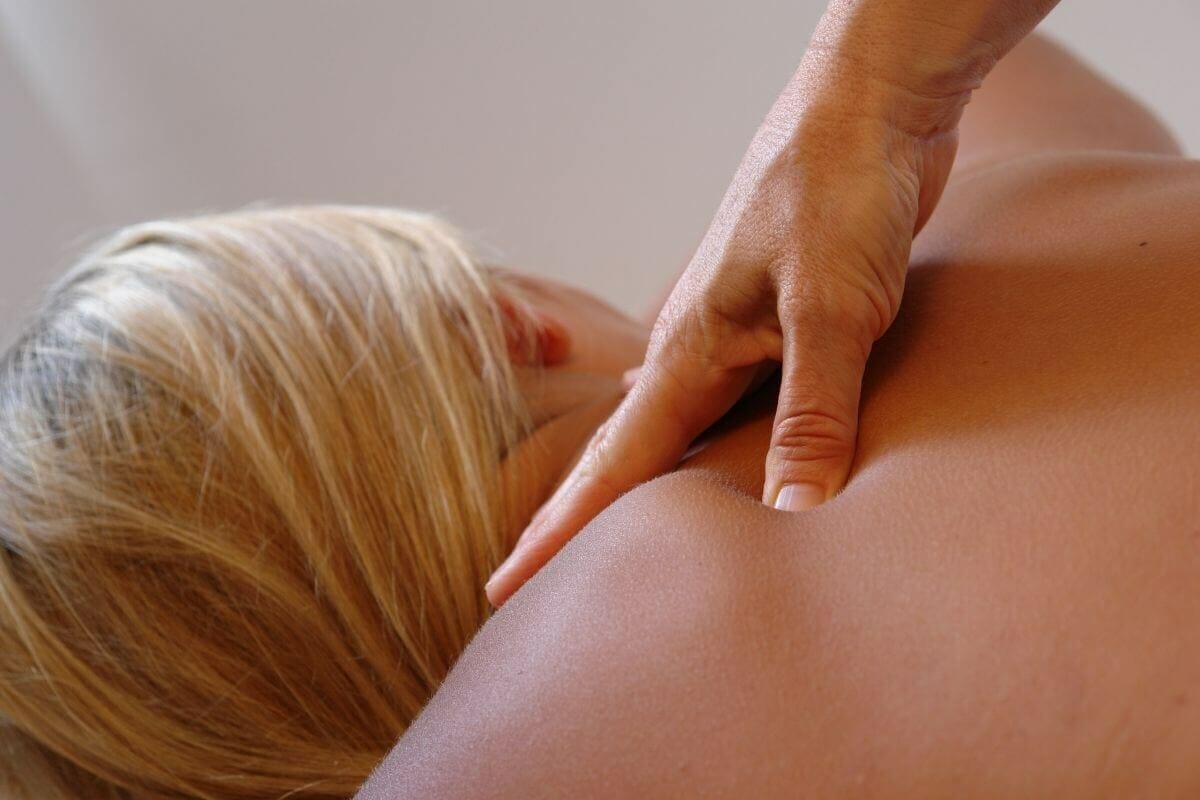
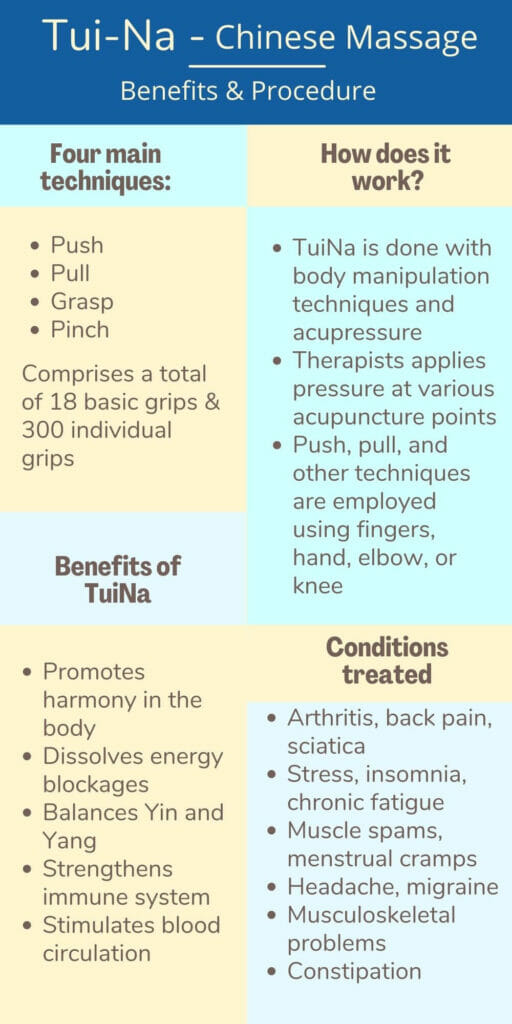
A Tui Na session is a hands-on, full-body experience. The practitioner targets specific acupuncture points (xuéwèi, 穴位). They apply pressure using the fingers, fist, elbow, or knee. The choice of tool depends on the area and the depth of treatment needed.
Tui Na draws on a rich set of techniques. These include rolling, pushing, rubbing, tapping, grasping, and pinching. The practitioner works along the meridians and manipulates the joints and muscles. They also use mobilisation, stretching, and isometric exercises where appropriate. In total, the system includes 18 basic grips and around 300 individual techniques.
Unlike acupuncture, Tui Na integrates the entire meridian into each treatment. Acupuncture targets isolated points with fine needles. Tui Na, however, works along the full length of each energy pathway. The result is a therapy that feels both deeply physical and profoundly holistic.
The Benefits of Tui Na
Tui Na restores energy flow and brings the body’s systems back into balance. Consequently, it supports healing across multiple dimensions — physical, emotional, and energetic. Key benefits include:
- Relief from pain and muscle cramps
- Deep relaxation of muscles and tendons
- Improved blood and lymphatic circulation
- A stronger immune system (via Wei Qi — the body’s defensive energy)
- Harmonisation of Yin and Yang
- Reduced stress and mental tension
- Renewed physical and mental energy
Moreover, Tui Na produces positive results for a wide range of specific conditions:
- Back pain and sciatica
- Arthritis and joint pain
- Headaches and migraines
- Carpal tunnel syndrome
- Insomnia
- Menstrual cramps
- Musculoskeletal problems and muscle spasms
- Constipation
- Chronic fatigue
- Stress-related conditions
You Might Also Like:
- Fennel In TCM – Know How To Use
- How Are TCM Herbs Classified?
- Arthritis Pain Relief | 6 Amazing Natural Remedies You Must Try
What to Expect: Comfort and Precautions
Tui Na is safe. It requires no special preparation before a session. That said, practitioners use a wide spectrum of techniques. Some are gentle and passive — these are Yin techniques. Others are vigorous and dynamic — these are Yang techniques.
A session can therefore feel soothing or quite intense. Some people notice mild bruising after stronger treatments. This happens when the therapist works on deep tension or blockages. It is normal and short-lived. If you have concerns about discomfort, discuss them with your practitioner beforehand. They will tailor the approach to your needs.
A Living Tradition, Tried and Tested by Time
Tui Na’s greatest proof of value is its longevity. Practitioners have refined it across two millennia of continuous use. It addresses the root causes of pain and illness — not just the symptoms. Additionally, it works on prevention, strengthening the body before illness takes hold.
Whether you seek relief from a specific condition or simply want to feel more vital and balanced, Tui Na offers a powerful path forward. Indeed, many people find that a few sessions transform not just how their bodies feel, but also how clearly they think and how well they sleep. Furthermore, practitioners can teach you self-massage principles to use at home, giving you an accessible tool for everyday health.
In short, Chinese TuiNa is not just ancient wisdom. It is practical, proven, and available to you today.
